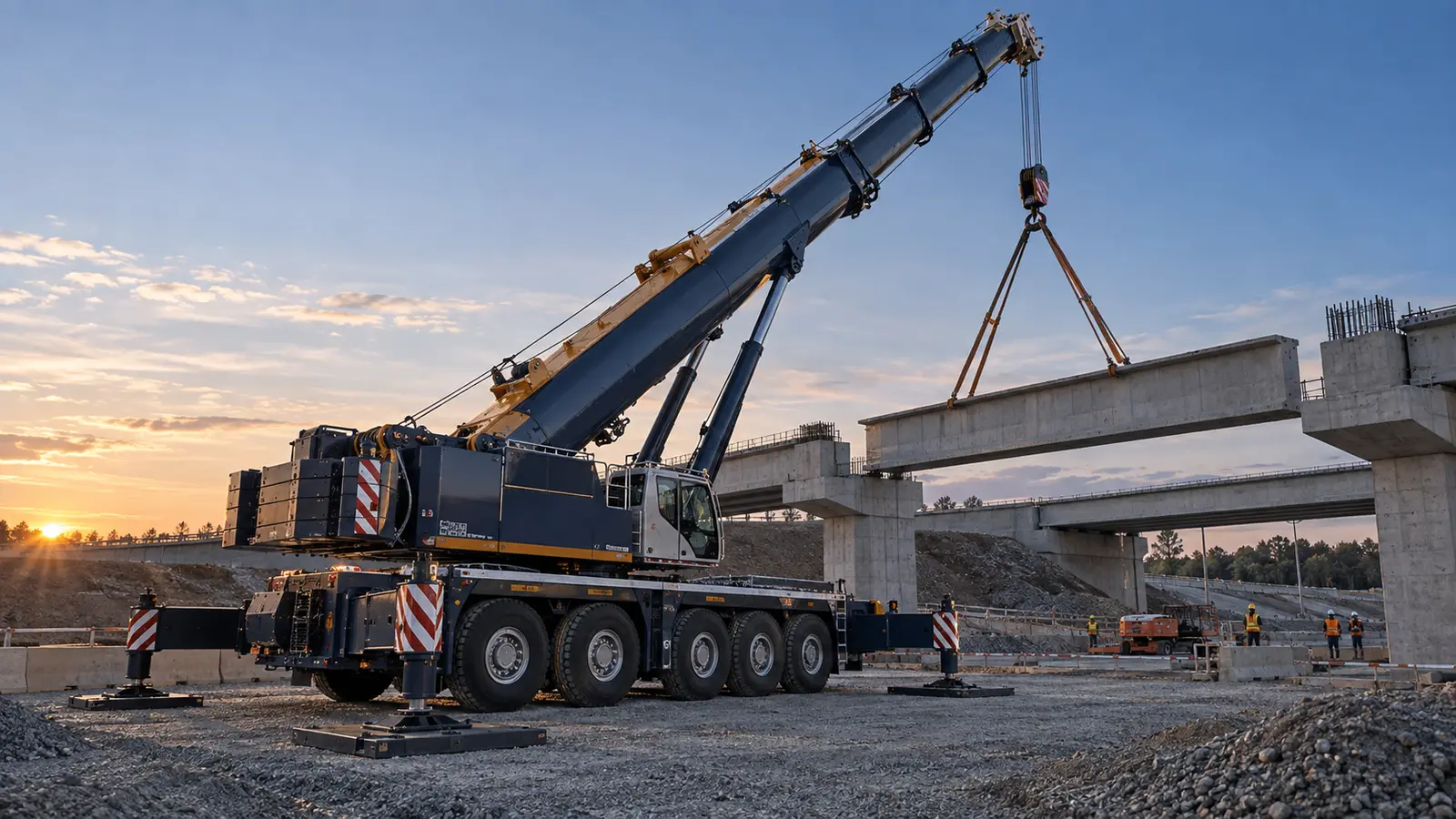
Lifting requirements on construction and infrastructure projects change as work progresses and access areas, heights, loads and programme stages shift. The enquiry therefore begins with the task, site sequence and known constraints, not only with a crane name. The scope may concern equipment supply, installation, service, relocation or project support, with the relevant family and missing information identified during review before any binding proposal.
Families for different site conditions
Potential families include top-slewing, luffing-jib or self-erecting tower cranes; all-terrain, rough-terrain or truck-mounted mobile cranes; lattice-boom or telescopic crawlers; and articulating loaders or compact cranes for constrained sites. The commercial family name does not establish capability. Load at working radius, height, access and programme are core review inputs before an option can be proposed.
Services and responsibility boundaries
The request may be supply only, installation and assembly, dismantling and relocation, maintenance and repair, or support for a planned work window. Access, coordination, auxiliary equipment, power and handover can cross project boundaries, so owner, contractor, operator and specialist responsibilities must be recorded clearly. This page does not provide a lift plan, foundation calculation or suitability guarantee; those are project-specific engineering and field outputs subject to the required approval.
What to send with the enquiry
Share the site layout, known pick and set points, load description, dimensions and weight, required working radius and height, access and positioning routes, programme and work sequence. Add available information on ground or surface conditions, adjacent constraints, power, drawings and photographs, with units stated clearly. If some data is not known, leave it open and identify who is expected to confirm it.
One project or several locations
Use the crane form for a defined equipment need, the service form for an existing asset, and the project form where packages, contractors, dates and documents overlap. In multi-location programmes, requirements are recorded for each site and stage rather than copying one description across all of them. Qualification produces a scope, responsibilities, open information and proposal stages; receiving the enquiry does not reserve equipment, mobilise a team or accept tender conditions automatically.
The next step
Start with a defined equipment, part or service enquiry, or use the project and tender form when several workstreams or locations overlap. The available information is reviewed first, after which the proposal identifies items, responsibilities, information gaps, stages, validity and approved terms without assuming unsupported specifications or commitments.