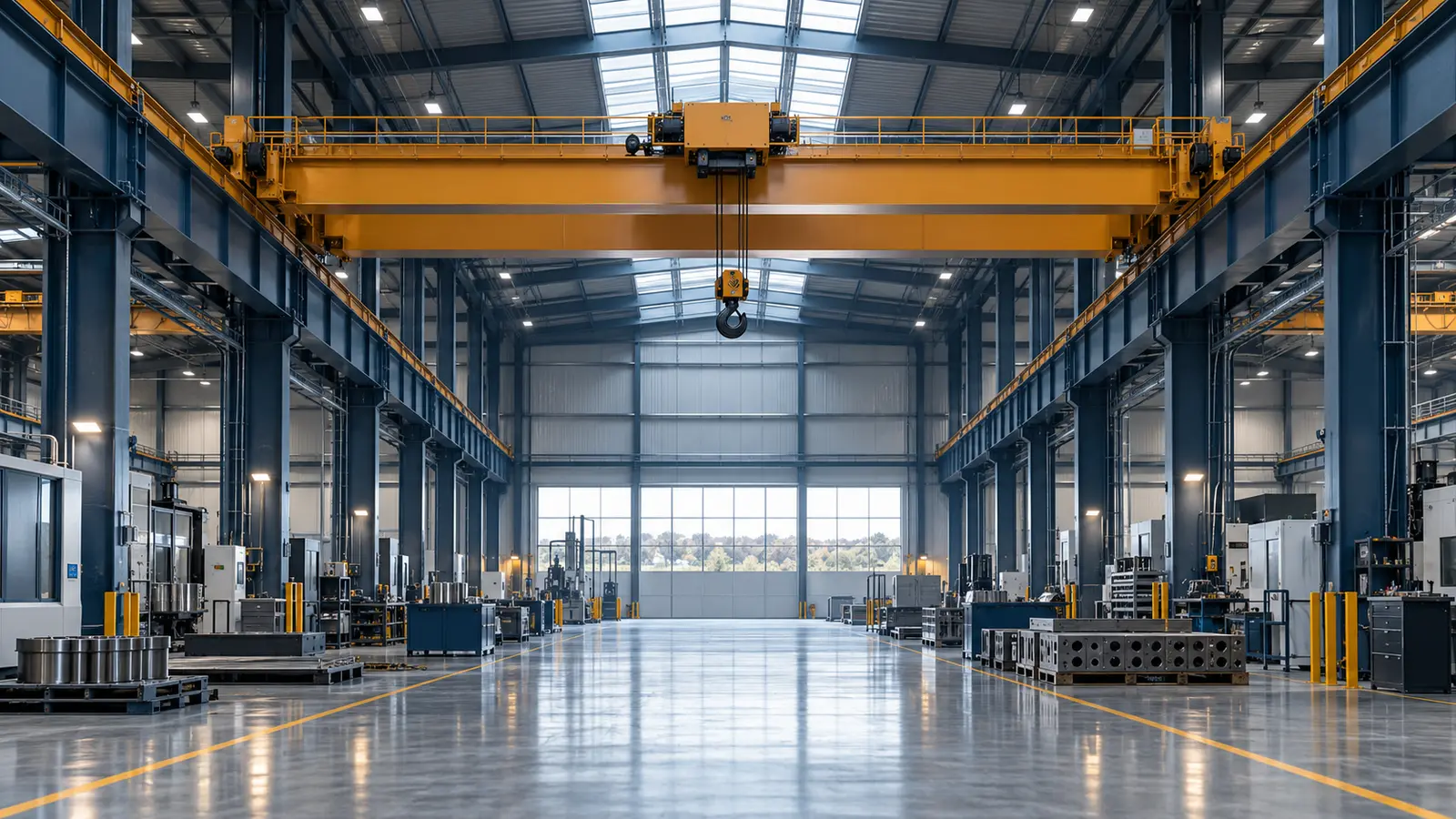
Factory lifting is connected to production sequence, building space and the movement of material between stations, not only to load weight. A customer may need one lifting point, several workstations, a crane serving a full line, or an upgrade to an existing asset during a planned shutdown. The enquiry starts with the process, location, and boundaries between equipment, structure, power and operations so the need can become a reviewable scope.
Lifting equipment within the factory
Relevant families may include single- or double-girder overhead cranes, underslung, gantry or semi-gantry cranes, jib cranes, workstation and monorail systems, and electric or manual hoists. Suitability varies with span, hook height, travel path, duty and the available structure. Options are presented as requestable families; no capacity or classification is confirmed until the application data and technical source have been reviewed.
Service and modernisation around production
An enquiry can cover supply and installation, preventive maintenance, repair, runway and mechanical rehabilitation, or electrical, controls and drive modernisation. Recurring parts can also be organised around the factory asset list or a defined shutdown programme. The proposal scope states included work, production interfaces, access and power responsibilities, and handover requirements; it does not assume a line shutdown, response time or operating result that has not been agreed.
Factory information to provide
Share the building layout and lifting points, handling sequence, load description, dimensions and centre where known, plus the required load, height and span with clear units. Add available structure, runway, power, environment, shift pattern and programme information, together with existing asset data, drawings and photographs for an upgrade enquiry. Also state whether the need is supply only, installation, service, or a connected package.
Bringing multiple lifting points into one brief
Where several stations or buildings are involved, the Factory Lift package can organise each lifting point, its requirements, and the connected equipment and services. Shared needs are separated from the differences in each area, and unknown fields remain visible for review. The result is a requirement schedule, boundaries, responsibilities and proposal stages, not a final engineering design or equipment commitment before the site and specification are verified.
The next step
Start with a defined equipment, part or service enquiry, or use the project and tender form when several workstreams or locations overlap. The available information is reviewed first, after which the proposal identifies items, responsibilities, information gaps, stages, validity and approved terms without assuming unsupported specifications or commitments.